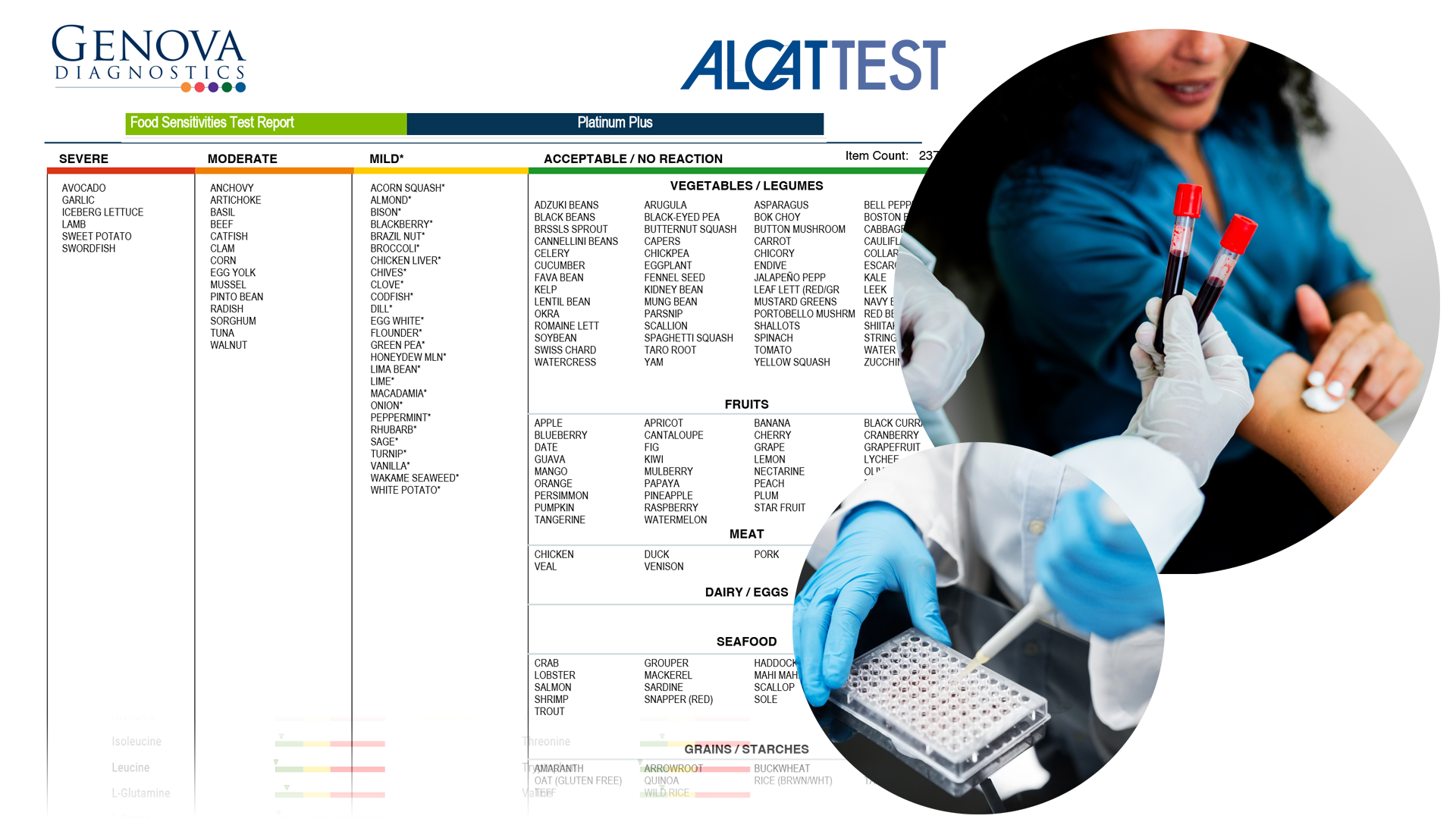
Identify food and chemical triggers that may be contributing to chronic inflammatory symptoms.
The Alcat Test helps personalize nutrition and lifestyle strategies by assessing how immune cells respond to foods, additives, chemicals, medicinal herbs, molds, and other substances. By measuring changes in leukocyte activity after exposure, Alcat Test helps uncover cellular reactions not captured by standard allergy testing.
This makes Alcat a valuable tool for complex, chronic, or difficult-to-explain symptoms, especially when conventional workups are unrevealing or when symptoms appear to fluctuate with diet, environment, or immune activation.
Alcat assesses cellular reactivity, revealing more than just antibody exposure.
Alcat evaluates immune cell response to foods, additives, chemicals, and other common exposures. This cellular approach offers a layer of insight beyond antibody-based testing, especially when chronic inflammation persists or standard evaluations don't fully explain the clinical picture.
Alcat Test complements GI assessment by adding a layer of insight on potential food or chemical exposures activating the immune system. Genova's GI Effects provides insight into digestive function, microbiome status, inflammation, and gut immune activity through markers such as secretory IgA, calprotectin, eosinophil protein X, and occult blood, while Alcat adds a practical way to evaluate potential dietary and environmental triggers that may be influencing inflammatory burden.
What the Alcat Test Measures
Alcat evaluates cellular immune response after exposing leukocytes, including neutrophils, lymphocytes, monocytes, eosinophils, and basophils, to potential triggers. Changes in white blood cell size, volume, and number are assessed as indicators of cellular reactivity.
This cellular approach is designed to capture immune cell activation patterns that occur in immunologic, toxic, pharmacologic, or inflammatory pathways. Clinical studies using Alcat Test results to guide dietary modification have reported significant improvements in a range of symptoms.1, 2, 7-9 The clinical utility of Alcat-guided dietary intervention has also been evaluated in double-blind and placebo-controlled study designs.10, 11
See Exactly What's Tested
Review panels, combinations, and a list of everything that's tested with Alcat.
When to consider testing?
The Alcat Test may be helpful for individuals who suspect that foods, additives, chemicals, or other environmental exposures are contributing to persistent symptoms, but who are unsure where to begin. For many people, tracking diet and symptoms can feel overwhelming, especially when reactions are delayed, inconsistent, or difficult to connect to a specific exposure.
Food and chemical sensitivities can contribute to symptoms that span multiple body systems, including gastrointestinal, neurologic, dermatologic, musculoskeletal, respiratory, and metabolic concerns.
Alcat Test provides personalized, actionable information that can help guide a more targeted elimination and reintroduction plan. Rather than starting with a broad or highly restrictive elimination diet, clinicians can use Alcat results to help prioritize which foods or substances may be most relevant to the patient's symptom pattern.
Consider Alcat Test for individuals with persistent or recurring symptoms that appear to be influenced by food, chemical, or environmental exposures, including:
| Gastrointestinal Symptoms |
bloating, abdominal discomfort, diarrhea, constipation, reflux, gastritis, IBS-like symptoms, suspected malabsorption |
| Neurologic and Energy Concerns |
migraines, headaches, brain fog, memory changes, fatigue, mood changes, difficulty concentrating |
| Skin Symptoms |
eczema, psoriasis, rashes, urticaria, acne, unexplained skin flares |
| Respiratory Symptoms |
chronic cough, wheezing, sinus congestion, recurrent upper airway irritation |
| Musculoskeletal Concerns |
aching joints, stiffness, tendon discomfort, inflammatory pain patterns |
| Metabolic and Hormonal Concerns |
weight-loss resistance, metabolic syndrome, blood sugar dysregulation, thyroid-related symptoms, menstrual irregularity, infertility when clinically appropriate |
| Immune and Inflammatory Presentations |
allergies, autoimmune patterns, recurrent infections, complex multisystem symptoms requiring a broader functional assessment |
Alcat Methodology is Unique
The Alcat Test evaluates immune cell reactivity by measuring how white blood cells respond when exposed to individual foods, additives, chemicals, medicinal herbs, molds, or other test substances. Using a whole-blood sample, the test challenges leukocytes ex vivo (outside the body) and measures changes in cell size, volume, and number that may occur during cellular activation.
This cellular approach is designed to assess innate immune activity, particularly the response of granulocytes such as neutrophils, which make up the majority of circulating white blood cells and play a central role in the body's first-line inflammatory defense. Acute neutrophil activation is essential for protecting the body from infection and injury. However, when immune activation becomes persistent or poorly regulated, inflammatory signaling may contribute to ongoing symptoms and physiologic stress.
By focusing on leukocyte activation rather than a single antibody class, the Alcat Test offers a different lens for evaluating potential dietary and environmental triggers.
Unlike classic IgE allergy testing, the Alcat Test is not designed to diagnose immediate, IgE-mediated food allergy or anaphylaxis risk. Instead, it is intended to help identify potential non-IgE cellular reactions that may be relevant in patients with delayed, complex, or difficult-to-trace symptom patterns. Results should always be interpreted in the context of the individual's history, symptoms, diet, medications, and other laboratory findings.
The Alcat Test also differs from IgG food antibody testing. IgG testing measures antibody response to food antigens, while Alcat Test evaluates cellular response. This distinction matters because food and chemical sensitivities may involve multiple pathways, including immunologic, toxic, pharmacologic, and inflammatory mechanisms. A cellular response may occur without direct antibody involvement, as activated immune cells can release inflammatory mediators, reactive oxygen species, and other signaling molecules.
Alcat Test Panel Components
Alcat offers flexible panel options, from comprehensive food and chemical sensitivity assessment to focused food-only testing. Platinum Plus and 250 Food Panel are the two most commonly selected options. Additional panels and combinations are available for specialized testing strategies.
Most Comprehensive
Platinum Plus
370 Items
The most popular Alcat option, designed for a comprehensive look at potential food, additive, mold, herb, medication, and chemical sensitivities.
Popular Food Panel
250 Foods
250 Items
A focused option for a broad dietary starting point without testing additives, molds, herbs, or medication-related agents.
-
250 Foods
-
Useful for targeted elimination and reintroduction planning
-
A practical choice when food exposures are the primary clinical question
Platinum Comprehensive 320 Items
200 Food Panel + 50 Medicinal Herbs, Functional Foods, and Adaptogens + 30 Food Additives, Colorings, and Preservatives + 20 Antibiotics and Anti-inflammatory Agents
Pediatric Wellness 81 Items
50 Food Panel + 30 Food Additives, Colorings, and Preservatives + Candida albicans
Comprehensive Wellness 1 250 Items
200 Food Panel + 30 Food Additives, Colorings, and Preservatives + 20 Molds
Comprehensive Wellness 2 230 Items
200 Food Panel + 30 Food Additives, Colorings, and Preservatives
Comprehensive Wellness 2 200 Items
150 Food Panel + 30 Food Additives, Colorings, and Preservatives + 20 Molds
50 Food Panel Base Panel
- Apple
- Baker's Yeast
- Banana
- Barley
- Beef
- Black Pepper
- Broccoli
- Butternut Squash
- Cabbage
- Cane Sugar
- Cantaloupe
- Carrot
- Casein
- Cauliflower
- Chicken
- Cinnamon
- Cocoa
- Corn
- Cow's Milk
- Egg White
- Egg Yolk
- Garlic
- Gliadin
- Gluten
- Grape
- Green Pea
- Iceberg Lettuce
- Lamb
- Lemon
- Mustard Seed
- Oat Gluten Free
- Onion
- Orange
- Peanut
- Pear
- Pollock
- Pork
- Rice Brown/White
- Shrimp
- Soybean
- Strawberry
- String Bean
- Sweet Potato
- Tomato
- Tuna
- Turkey
- Vanilla
- Wheat
- White Potato
- Yellow Squash
100 Food Panel 50 Foods Panel Plus Items Below
- Almond
- Asparagus
- Avocado
- Basil
- Bell Pepper
- Black Tea
- Blueberry
- Brewer's Yeast
- Brussels Sprouts
- Button Mushrooms
- Candida albicans
- Carob
- Cashew
- Celery
- Cherry
- Clam
- Coconut
- Codfish
- Coffee
- Crab
- Cranberry
- Cucumber
- Eggplant
- Ginger
- Goat's Milk
- Grapefruit
- Green Tea
- Halibut
- Honey
- Hops
- Lime
- Lobster
- Millet
- Olive
- Oregano
- Parsley
- Peach
- Pecan
- Pineapple
- Pinto Beans
- Plum
- Rye
- Salmon
- Scallop
- Sesame
- Snapper
- Sole
- Spinach
- Watermelon
- Whey
150 Food Panel 100 Foods Panel Plus Items Below
- Amaranth
- Apricot
- Artichoke
- Bay Leaf
- Black Beans
- Black-Eyed Pea
- Blackberry
- Buckwheat
- Caraway
- Cayenne Pepper
- Chickpea
- Clove
- Cumin
- Date
- Dill
- Duck
- Fig
- Flaxseed
- Haddock
- Hazelnut
- Honeydew Melon
- Kidney Bean
- Kiwi
- Lentil Bean
- Lima Bean
- Malt
- Mango
- Navy Bean
- Nutmeg
- Oyster
- Papaya
- Paprika
- Peppermint
- Pistachio
- Pumpkin
- Radish
- Raspberry
- Red Beet
- Safflower
- Sage
- Sardine
- Sea Bass
- Sunflower
- Tapioca
- Thyme
- Tilapia
- Trout
- Turnip
- Veal
- Walnut
200 Food Panel 150 Foods Panel Plus Items Below
- Acorn Squash
- Ancho Chili Pepper
- Anchovy
- Bison
- Bok Choy
- Brazil Nut
- Cardamom
- Catfish
- Chamomile
- Cilantro
- Coriander Seed
- Endive
- Fava Bean
- Fennel Seed
- Flounder
- Grouper
- Jalapeño Pepper
- Kale
- Kelp
- Leaf Lettuce Red/Green
- Leek
- Licorice
- Macadamia
- Mackerel
- Mahi Mahi
- Maple Sugar
- Monk Fruit
- Mung Bean
- Mussel
- Nectarine
- Okra
- Parsnip
- Pine Nut
- Pomegranate
- Portobello Mushroom
- Quinoa
- Romaine Lettuce
- Rosemary
- Saffron
- Scallion
- Sorghum
- Spelt
- Swiss Chard
- Swordfish
- Teff
- Turmeric
- Venison
- Watercress
- Wild Rice
- Zucchini Squash
250 Food Panel 200 Foods Panel Plus Items Below
- Adzuki Beans
- Agave
- Allspice
- Allulose
- Arrowroot
- Arugula
- Black Currant
- Boston Bibb Lettuce
- Cannellini Beans
- Capers
- Chia
- Chicory
- Chives
- Collard Greens
- Dandelion Leaf
- Dragon Fruit
- Escarole
- Guava
- Habanero Pepper
- Hemp
- Horseradish
- Jackfruit
- Jicama
- Lactose
- Lychee
- Molasses
- Mulberry
- Mustard Greens
- Nori
- Nutritional Yeast
- Persimmon
- Plantain
- Poppy Seed
- Rapeseed
- Red Palm Fruit
- Rhubarb
- Rutabaga
- Shallot
- Sheep's Milk
- Shiitake Mushroom
- Spaghetti Squash
- Spearmint
- Star Fruit
- Stevia
- Tangerine
- Taro Root
- Tarragon
- Wakame Seaweed
- Water Chestnut
- Yellow Pea
150 Vegetarian Food Panel
- Almond
- Ancho Chili Pepper
- Apple
- Apricot
- Artichoke
- Asparagus
- Avocado
- Baker's Yeast
- Banana
- Barley
- Basil
- Bay Leaf
- Bell Pepper
- Black Pepper
- Black-Eyed Pea
- Black Tea
- Blackberry
- Blueberry
- Brazil Nut
- Brewer's Yeast
- Broccoli
- Brussels Sprouts
- Buckwheat
- Button Mushroom
- Cabbage
- Candida albicans
- Cane Sugar
- Cantaloupe
- Caraway
- Carob
- Carrot
- Casein
- Cashew
- Cauliflower
- Cayenne Pepper
- Celery
- Chamomile
- Cherry
- Chickpea
- Cinnamon
- Clove
- Cocoa
- Coconut
- Coffee
- Corn
- Cow's Milk
- Cranberry
- Cucumber
- Cumin
- Date
- Dill
- Egg White
- Egg Yolk
- Eggplant
- Endive
- Fava Bean
- Fig
- Flaxseed
- Garlic
- Ginger
- Gliadin
- Gluten
- Grape
- Grapefruit
- Green Pea
- Hazelnut
- Honey
- Honeydew Melon
- Hops
- Iceberg Lettuce
- Jalapeño Pepper
- Kale
- Kelp
- Kidney Bean
- Kiwi
- Leek
- Lemon
- Lentil Bean
- Lima Bean
- Lime
- Macadamia
- Malt
- Mango
- Maple Sugar
- Millet
- Monk Fruit
- Mung Bean
- Mustard Seed
- Navy Bean
- Nectarine
- Nori
- Nutmeg
- Oat Gluten Free
- Okra
- Olive
- Onion
- Orange
- Oregano
- Papaya
- Paprika
- Parsley
- Parsnip
- Peach
- Peanut
- Pear
- Pecan
- Peppermint
- Pine Nut
- Pineapple
- Pinto Bean
- Pistachio
- Plum
- Pomegranate
- Portobello Mushroom
- Pumpkin
- Radish
- Raspberry
- Red Beet
- Rhubarb
- Rice Brown/White
- Romaine Lettuce
- Rosemary
- Rye
- Saffron
- Sage
- Sesame
- Sorghum
- Soybean
- Spinach
- Strawberry
- String Bean
- Sunflower
- Sweet Potato
- Swiss Chard
- Tapioca
- Tarragon
- Thyme
- Tomato
- Turmeric
- Turnip
- Vanilla
- Wakame Seaweed
- Walnut
- Watermelon
- Wheat
- Whey
- White Potato
- Yellow Pea
- Yellow Squash
- Zucchini Squash
200 Vegetarian Food Panel 150 Vegetarian Foods Panel Plus Items Below
- Acorn Squash
- Adzuki Beans
- Arrowroot
- Arugula
- Black Beans
- Black Currant
- Bok Choy
- Boston Bibb Lettuce
- Butternut Squash
- Cannellini Beans
- Capers
- Cardamom
- Chia
- Chicory
- Chives
- Cilantro
- Collard Greens
- Coriander
- Dandelion Leaf
- Escarole
- Fennel Seed
- Goat's Milk
- Guava
- Hemp
- Horseradish
- Lactose
- Leaf Lettuce Red/Green
- Licorice
- Lychee
- Molasses
- Mulberry
- Mustard Greens
- Nutritional Yeast
- Persimmon
- Quinoa
- Safflower
- Scallion
- Shallot
- Shiitake Mushroom
- Spaghetti Squash
- Spearmint
- Spelt
- Star Fruit
- Stevia
- Tangerine
- Taro Root
- Teff
- Water Chestnut
- Watercress
- Wild Rice
50 Medicinal Herbs, Functional Foods, and Adaptogens
- Açai Berry
- Aloe Vera
- Ashwagandha
- Astragalus
- Bamboo Shoot
- Barley Grass
- Bee Pollen
- Bilberry
- Black Walnut
- Cascara
- Chlorella
- Chondroitin
- Dandelion Root
- Echinacea angustifolia
- Elderberry
- Essiac
- Feverfew
- Ginkgo Biloba
- Glucosamine
- Goji Berry
- Goldenseal
- Grape Seed Extract
- Guarana Seed
- Gymnema Sylvestre
- Hawthorn Berry
- Heartwood Red Quebracho
- Huperzine
- Kava Kava
- Lutein
- Maitake Mushroom
- Milk Thistle Silymarin
- Moringa
- Mullein Leaf
- Noni Berry
- Pau d'Arco Bark
- Pine Bark Pycnogenol
- Red Yeast Rice
- Reishi Mushroom
- Resveratrol
- Rhodiola
- Rooibos Tea
- Schisandra Berry
- Senna
- Spirulina
- St John's Wort
- Valerian
- Vinpocetine
- Wheatgrass
- Wormwood
- Yellow Dock
50 Female Herbs
- Alfalfa Leaf
- Arnica
- Black Cohosh
- Blessed Thistle
- Blue Cohosh
- Boswellia
- Buchu Leaf
- Bupleurum
- Burdock
- Butcher's Broom Root
- Calendula
- Cat's Claw
- Chaparral Root
- Chasteberry
- Cramp Bark
- Damiana
- Dong Quai
- Evening Primrose
- False Unicorn
- Fo-Ti Root
- Gotu Kola
- Horse Chestnut
- Horsetail
- Irish Moss
- Juniper Berry
- Korean Ginseng
- Lavender
- Lemon Balm
- Lobelia
- Maca Root
- Marshmallow Root
- Mistletoe
- Motherwort
- Myrrh
- Nettle Leaf
- Partridge Berry
- Pennyroyal
- Peony Root
- Red Clover Flower
- Red Raspberry Leaf
- Rehmannia
- Sarsaparilla
- Siberian Ginseng
- Skull Cap
- Slippery Elm
- Uva Ursi
- White Willow Bark
- Wild Yam Root
- Yarrow
- Yerba Maté
40 Male Herbs
- Alfalfa Leaf
- American Ginseng
- Arnica
- Burdock
- Butcher's Broom Root
- Calendula
- Cat's Claw
- Catuaba
- Chaparral Root
- Cnidium Monnieri
- Damiana
- Deer Antler Velvet
- Dong Quai
- Fo-Ti Root
- Gotu Kola
- Horny Goat Weed
- Irish Moss
- Juniper Berry
- Korean Ginseng
- Lobelia
- Lycopene
- Maca Root
- Mistletoe
- Mucuna Pruriens
- Muira Puama
- Myrrh
- Nettle Leaf
- Pumpkin Seed
- Pygeum Bark
- Rehmannia
- Sarsaparilla
- Saw Palmetto
- Siberian Ginseng
- Skull Cap
- Stinging Nettle Root
- Tribulus Terrestris
- Uva Ursi
- Yarrow
- Yerba Maté
- Yohimbe Bark
40 Environmental Chemicals, Preservatives, and Expanded Additives
- Acacia Gum
- Adipic Acid
- Ammonium Chloride
- Calcium Phosphate
- Carrageenan
- Chlorine
- Cyclodextrin
- D-Lactitol
- Deltamethrin
- EDTA Ethylenediaminetetraacetic Acid
- Fluoride
- Fumaric Acid
- Glyphosate
- Glycerol
- Hexylresorcinol
- Invertase
- Isomalt
- Lysozyme
- Magnesium Phosphate
- Malic Acid
- Maltodextrin
- Mannitol
- Methenamine Hexamethylenetetramine
- Methyl Anthranilate
- Nickel Sulfate
- Phosphoric Acid
- Polydextrose
- Potash Potassium Hydroxide
- Potassium Phosphate
- Potassium Sorbate
- Potassium Tartrate
- Sodium Acetate
- Sodium Benzoate
- Sodium Bisulfate
- Sodium Lactate
- Sodium Lauryl Sulfate SLS
- Sodium Propionate
- Sodium Pyrophosphate
- Sodium Tripolyphosphate
- Succinic Acid
30 Food Additives, Colorings, and Preservatives
- Acid Blue #3 Xylene Blue V
- Acid Red #14
- Annatto
- Aspartame
- Benzoic Acid
- BHA Butylated Hydroxyanisole
- BHT Butylated Hydroxytoluene
- Blue #1 Brilliant Blue
- Blue #2 Indigo Carmine
- Brilliant Black
- Citric Acid
- Erythritol
- High Fructose Corn Syrup
- Green #3 Fast Green
- Soy Lecithin
- MSG Monosodium Glutamate
- Orris Root
- Polysorbate 80
- Red #4 Carmine
- Red #40 Allura Red
- Saccharin
- Sodium Sulfite
- Sorbic Acid
- Sucralose
- Titanium Dioxide
- Xylitol
- Yellow #5 Tartrazine
- Yellow #6 Sunset Yellow
20 Antibiotics and Anti-inflammatory Agents
- Acetaminophen Tylenol
- Amoxicillin
- Ampicillin
- Aspirin Acetylsalicylic Acid
- Diclofenac Voltaren
- Diflunisal Dolobid
- Gentamicin
- Ibuprofen Advil/Motrin
- Indomethacin
- Ketoprofen
- Naproxen Aleve
- Neomycin
- Nystatin
- Penicillamine
- Penicillin
- Piroxicam Feldene
- Streptomycin
- Sulfamethoxazole
- Sulindac Clinoril
- Tetracycline
21 / 20 Molds
- Alternaria alternata
- Aspergillus fumigatus
- Botrytis cinerea
- Candida albicans
- Cephalosporium gramineum
- Cladosporium herbarum
- Curvularia
- Epicoccum nigrum
- Fusarium oxysporum
- Geotrichum candidum
- Helminthosporium
- Hormodendrum cladosporium
- Monilia sitophila
- Mucor racemosus
- Penicillium Notatum
- Phoma herbarum
- Pullularia aureobasidium
- Rhizopus Nigricans
- Rhodotorula rubra
- Spondylocladium
- Trichoderma
References
- Solomon, B., The ALCAT Test- A Guide and Barometer in the Therapy of Environmental and Food Sensitivities. Environmental Medicine, 1992. 9(1 & 2)
- Mylek, D., ALCAT Test results in the treatment of respiratory and gastrointestinal symptoms, arthritis, skin and central nervous system. Rocz Akad Med Bialymst, 1995. 40(3): p. 625-9.
- Miesel R, Hartung R,,Kroeger H, Priming of NADPH oxidase by tumor necrosis factor alpha in patients with inflammatory and autoimmune rheumatic diseases. Inflammation, 1996. 20(4): p. 427-38.
- Bastard JP, Maachi M, Lagathu C, Kim MJ, Caron M, Vidal H, Capeau J, Feve B. Recent advances in the relationship between obesity, inflammation, and insulin resistance. Eur Cytokine Netw, 2006. 17(1): p. 4-12.
- Sapone A, Lammers KM, Casolaro V, Cammarota M, Giuliano MT, De Rosa M, Stefanile R, Mazzarella G, Tolone C, Russo MI, Esposito P, Ferraraccio F,Cartenì M, Riegler G, de Magistris L, Fasano A. Divergence of gut permeability and mucosal immune gene expression in two gluten-associated conditions: celiac disease and gluten sensitivity. BMC Med, 2011. 9: p. 23.
- Odegaard JI, Chawla A. Connecting Type 1 and Type 2 Diabetes through innate immunity. Cold Spring Harb Perspect Med, 2012. 2(3).
- Sandberg D, Pasula MJ, A Comparison of the Alcat Test for Food Reactions amongst 2 Population Sub-Groups, in 45th Annual Congress of the American College of Allergy and Immunology1988, Annals of Allergy: Los Angeles.
- Buczyłko K, Obarzanowski T, Rosiak K, Staśkiewicz G, Fiszer A, Chmielewski S, Kowalczyk J. Prevalence of food allergy and intolerance in children based on MAST CLA and ALCAT tests. Rocz Akad Med Bialymst, 1995. 40(3): p. 452-6.
- Kaats G, Pullin D, Parker L, The Short Term Efficacy of the ALCAT Test of Food Sensitivities to Facilitate Changes in Body Composition and Self-Reported Disease Symptoms: A Randomized Controlled Study. Am J of Bariatric Med, 1996: p.18-23.
- Fell P, Brostoff J, Pasula MJ. High Correlation of the Alcat Test Results with Double Blind Challenge (DBC) in Food Sensitivity, in 45th Annual Congress of the American College of Allergy and Immunology1988, Annals of Allergy: Los Angeles.
- Hoj L. Diagnostic Value of ALCAT Test in Intolerance to Food Additives Compared With Double-Blind Placebo-Controlled (DBPC) Oral Challenges, in 52nd annual meeting of the American Academy of Allergy, Asthma & Immunology1996, Journal of Allergy and Clinical Immunology: New Orleans.
- PJ, Srn SS, Brostoff J. Cellular responses to food in irritable Bowel Syndrome- an investigation of the Alcat test. Journal of Nutritional Medicine, 1991. 2: p. 143-149.
- Berardi L. De Amici M. Vignini A. Mantegna G. Mosca M. ALCAT test identifies food intolerance in patients with gastrointestinal symptoms in The XXVIII European Academy of Allergy and Clinical Immunology Congress Warsaw 2009, European Journal of Allergy and Clinical Immunology: Warsaw
- Akmal M, Khan S, Khan A, The Effect of the ALCAT Test Diet Therapy for Food Sensitivity in Patient's With Obesity. Middle East Journal of Family Medicine, 2009. 7(3).
- Lee, MS, Role of innate immunity in diabetes and metabolism: recent progress in the study of inflammasomes. Immune Netw, 2011. 11(2): p. 95-9.
- Berardi L, De Amici M, Vignini A, Torre C, Mosca M. Food intolerance in patients with cutaneous diseases: diagnostic value of the ALCAT test, in The XXVIII European Academy of Allergy and Clinical Immunology Congress Warsaw 2009, European Journal of Allergy and
- De Amici M, Berardi L, Castello M, Mantegna G, Giunta V, Ronzi G, Vignini M. Evaluation of ALCAT Test results in the non IgE-mediated pathology of the skin, in 30th Congress of the European Academy of Allergy and Clinical Immunology2011, Allergy: Istanbul.
- Jyonouchi, H. Food allergy and autism spectrum disorders: is there a link? Curr Allergy Asthma Rep, 2009. 9(3): p. 194-201.
- Dickerson F, Stallings C, Origoni A, Vaughan C, Khushalani S, Yolken R. Markers of gluten sensitivity in acute mania: a longitudinal study. Psychiatry Res, 2012. 196(1): p. 68-71.