Genova Diagnostics
{{showNavMenu ? 'close' : 'menu'}}
{{showSearchBar ? 'close' : 'search'}}
Collection Pack
Collection Pack
Early Detection of Alzheimer's Disease with the p-Tau217 Biomarker

Specimen Type: Plasma

Turnaround Time: 14 Days

Not available in New York state.

Only healthcare providers licensed in their state may order laboratory testing. 

Turnaround times are estimates. Detailed order tracking is available in myGDX.

Find a Doctor Provider Login / Order

Why choose Genova Diagnostics' Alzheimer's Assessment (p-Tau217)?

Groundbreaking
Biomarker Detection

Utilizes the groundbreaking p-Tau217 biomarker for early and accurate detection of Alzheimer's disease (AD).1 

Convenient and
Cost-Effective

A simple blood draw makes testing more accessible and cost-effective compared to lumbar puncture or imaging studies.

Highly Accurate
Results

p-Tau217 shows a strong correlation with PET imaging and cerebrospinal fluid (CSF) testing, ensuring highly accurate results.1

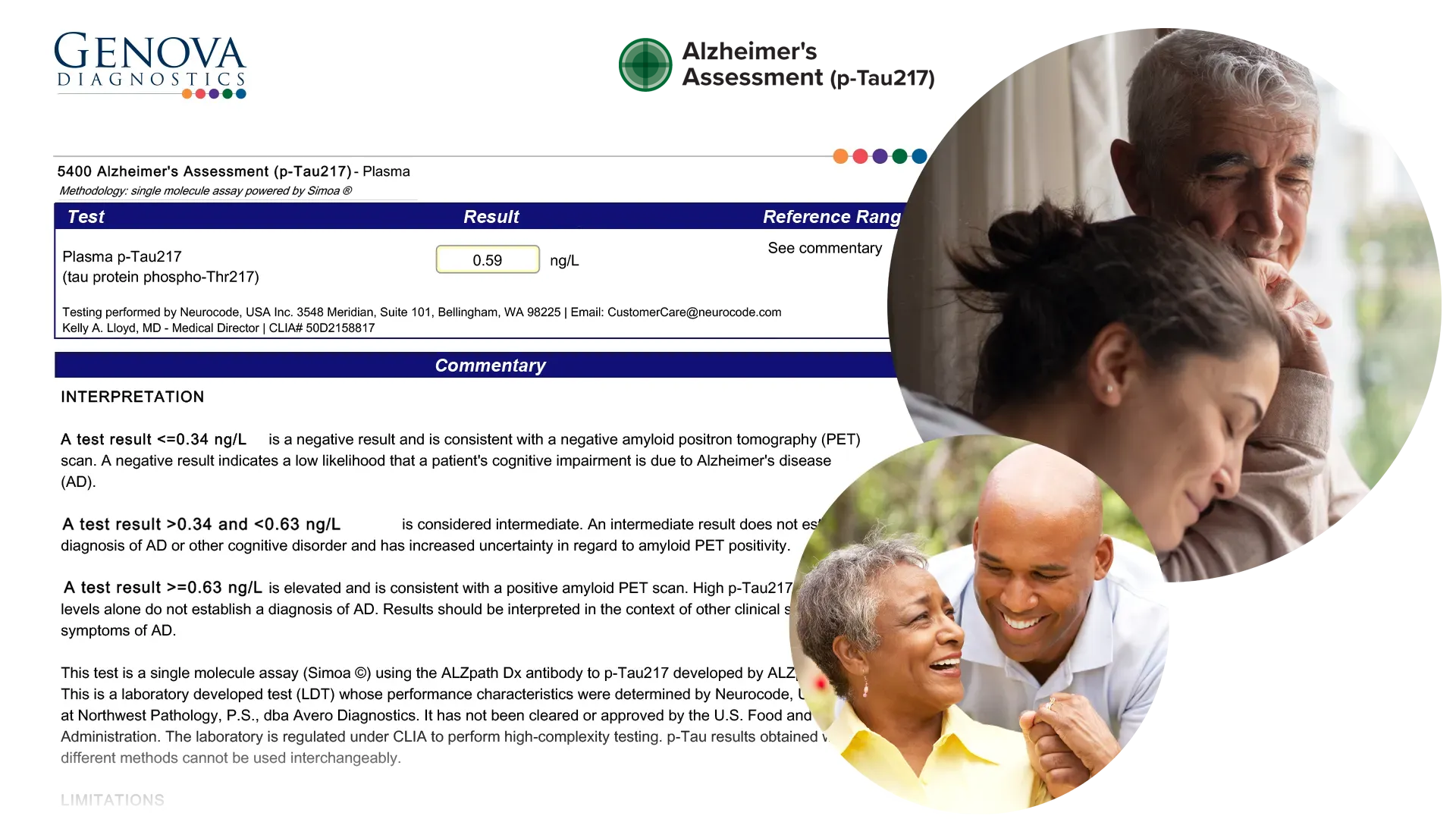
Genova's Alzheimer's Assessment measures plasma p-Tau217, a reliable aid in diagnosing Alzheimer's disease (AD).1

This assay helps detect AD pathology, including extracellular amyloid-beta plaques and intracellular neurofibrillary tangles of hyperphosphorylated tau (p-tau), before the onset of clinical symptoms.

Video thumbnail
Webinar
Unlocking Alzheimer's: The Power of p-Tau217

Dr. Dale Bredesen and Dr. Kaj Blennow explore one of the most talked-about biomarkers for Alzheimer's disease - plasma p-Tau217. Recognized globally as a potential game-changer, p-Tau217 has been featured in thousands of news outlets and is emerging as a leading tool for early detection and diagnosis.

Who should test?

The Alzheimer's Assessment (p-Tau217) is intended for adult patients aged 45 and older who present with cognitive impairment and are being evaluated for AD or other causes of cognitive decline.

There are comorbid conditions that may affect phosphorylated tau levels in the blood. These can include conditions affecting hepatic and renal function, such as chronic kidney disease (CKD), as well as a history of stroke or myocardial infarction. Certain medications to support kidney function may also play a role in heightened levels of p-Tau217. Additionally, differences in results based on racial and ethnic background, sex, and age have not yet been established.

Background:

Alzheimer's disease (AD) is a neurodegenerative disorder hallmarked by extracellular amyloid plaques and intraneuronal neurofibrillary tangles of phosphorylated Tau (p-Tau) in the brain. The tau protein normally maintains microtubules assembly and stability of neuronal axons; however, tau protein with excessive phosphorylation can have pathological consequences. In patients with AD, aggregates of p-Tau can be detected by postmortem neuropathology evaluation or pre-mortem positron tomography (PET) imaging with specific tracers. Soluble p-Tau also accumulates in the CSF and can be detected in lumbar puncture samples, and ultra-sensitive methods including the technique used here can accurately detect p-Tau levels in the blood, which correlate well with CSF levels and with brain amyloid plaque burden. Plasma p-tau217 levels correlate with amyloid-PET imaging and are more sensitive and specific than p-tau181 in distinguishing AD from other neurodegenerative disorders.


References
  1. Ashton NJ, Brum WS, Di Molfetta G, et al. Diagnostic Accuracy of a Plasma Phosphorylated Tau 217 Immunoassay for Alzheimer Disease Pathology. JAMA neurology. 2024;81(3):255-263.
  2. NIA-AA. Revised Criteria for Diagnosis and Staging of Alzheimer's Disease: Alzheimer's Association Workgroup. DRAFT Body Text as of October 9, 2023, 2021.
  3. Noble W, Hanger DP, Miller CC, Lovestone S. The importance of tau phosphorylation for neurodegenerative diseases. Front Neurol. 2013;4:83.
  4. Telser J, Risch L, Saely CH, Grossmann K, Werner P. P-tau217 in Alzheimer's disease. Clinica chimica acta; international journal of clinical chemistry. 2022;531:100-111.
  5. Berry K, Asken BM, Grab JD, et al. Hepatic and renal function impact concentrations of plasma biomarkers of neuropathology. Alzheimer's & Dementia (Amsterdam, Netherlands). 2022;14(1):e12321.
  6. Mielke MM, Dage JL, Frank RD, et al. Performance of plasma phosphorylated tau 181 and 217 in the community. Nature medicine. 2022;28(7):1398-1405.
  7. Gouda M, Antwi-Berko D, van Leeuwenstijn MS, et al. Plasma phosphorylated tau 217 levels are highly stable under common pre-analytical sample handling procedures. Alzheimer's & Dementia. 2023;19:e078393.

 

Genova's Alzheimer's Assessment measures plasma p-Tau217, a reliable aid in diagnosing Alzheimer's disease (AD).1

This assay helps detect AD pathology, including extracellular amyloid-beta plaques and intracellular neurofibrillary tangles of hyperphosphorylated tau (p-tau), before the onset of clinical symptoms.

Video thumbnail
Webinar
Unlocking Alzheimer's: The Power of p-Tau217

Dr. Dale Bredesen and Dr. Kaj Blennow explore one of the most talked-about biomarkers for Alzheimer's disease - plasma p-Tau217. Recognized globally as a potential game-changer, p-Tau217 has been featured in thousands of news outlets and is emerging as a leading tool for early detection and diagnosis.

Who should test?

The Alzheimer's Assessment (p-Tau217) is intended for adult patients aged 45 and older who present with cognitive impairment and are being evaluated for AD or other causes of cognitive decline.

There are comorbid conditions that may affect phosphorylated tau levels in the blood. These can include conditions affecting hepatic and renal function, such as chronic kidney disease (CKD), as well as a history of stroke or myocardial infarction. Certain medications to support kidney function may also play a role in heightened levels of p-Tau217. Additionally, differences in results based on racial and ethnic background, sex, and age have not yet been established.

Background:

Alzheimer's disease (AD) is a neurodegenerative disorder hallmarked by extracellular amyloid plaques and intraneuronal neurofibrillary tangles of phosphorylated Tau (p-Tau) in the brain. The tau protein normally maintains microtubules assembly and stability of neuronal axons; however, tau protein with excessive phosphorylation can have pathological consequences. In patients with AD, aggregates of p-Tau can be detected by postmortem neuropathology evaluation or pre-mortem positron tomography (PET) imaging with specific tracers. Soluble p-Tau also accumulates in the CSF and can be detected in lumbar puncture samples, and ultra-sensitive methods including the technique used here can accurately detect p-Tau levels in the blood, which correlate well with CSF levels and with brain amyloid plaque burden. Plasma p-tau217 levels correlate with amyloid-PET imaging and are more sensitive and specific than p-tau181 in distinguishing AD from other neurodegenerative disorders.


References
  1. Ashton NJ, Brum WS, Di Molfetta G, et al. Diagnostic Accuracy of a Plasma Phosphorylated Tau 217 Immunoassay for Alzheimer Disease Pathology. JAMA neurology. 2024;81(3):255-263.
  2. NIA-AA. Revised Criteria for Diagnosis and Staging of Alzheimer's Disease: Alzheimer's Association Workgroup. DRAFT Body Text as of October 9, 2023, 2021.
  3. Noble W, Hanger DP, Miller CC, Lovestone S. The importance of tau phosphorylation for neurodegenerative diseases. Front Neurol. 2013;4:83.
  4. Telser J, Risch L, Saely CH, Grossmann K, Werner P. P-tau217 in Alzheimer's disease. Clinica chimica acta; international journal of clinical chemistry. 2022;531:100-111.
  5. Berry K, Asken BM, Grab JD, et al. Hepatic and renal function impact concentrations of plasma biomarkers of neuropathology. Alzheimer's & Dementia (Amsterdam, Netherlands). 2022;14(1):e12321.
  6. Mielke MM, Dage JL, Frank RD, et al. Performance of plasma phosphorylated tau 181 and 217 in the community. Nature medicine. 2022;28(7):1398-1405.
  7. Gouda M, Antwi-Berko D, van Leeuwenstijn MS, et al. Plasma phosphorylated tau 217 levels are highly stable under common pre-analytical sample handling procedures. Alzheimer's & Dementia. 2023;19:e078393.

 

How it Works

Consult Doctor

Your doctor will discuss your symptoms and help decide which test is right for you.

Many specimen collections can be completed from the privacy of your home.

chevron_right
Activate Test

Collection packs can be dropshipped directly to your home and everything you need to begin testing is included.

Already have a collection pack? Activate your test and begin today.

chevron_right
Collect Samples

Use a calendar to plan for your collection.

Follow instructions carefully and be sure to add important details about you and your specimens in the Activation portal.

chevron_right
Ship to Lab

Ship your specimens using the prepaid FedEx materials provided.

Results are available online. Schedule time with your physician to review results and create a plan for your health.

FAQ

The collection instructions on the Support Materials tab include pertinent test preparation considerations.

We provide a variety of testing services, and some of them may or may not be covered by your insurance plan.

Once your physician has ordered a Genova Diagnostics test for you, you can submit the CPT codes for your test to your commercial insurance plan to determine coverage. For information about billing options, please visit the Billing Information page.

The Sample Report on the Support Materials tab reflects the interpretation guidance that is included on the live reports. Additional educational materials can be found in our Learning Library.

Genova also offers complimentary Medical Education Consultations for healthcare providers. Schedule consults online by signing in to your myGDX account.